Bishop Montague's Tomb, Bath Abbey
30th January 2025
The Abbey Church of Saint Peter and Saint Paul (Bath Abbey) was founded in the 7th Century originally as a convent later becoming a monastery. Monks fleeing reforms in France in the mid 10th century were given the church in Bath by King Edward I. During the early 12th Century, a building on a grander scale started to be built dedicated to St Peter and St Paul, with work taking around 50 years to complete. The monks were later encouraged to adopt the rule of St Benedict, and this religious community remained until the Dissolution of the Monasteries with the Prior surrendering it to the crown in January 1539. The building was sold to a Humphry Coles and stripped of much of its valuable materials, including glass, ironwork and lead. It was then left empty and began to decay. The building was sold on to a Matthew Colthurst in 1543 before his son gave it to the corporation of Bath in 1572. Queen Elizabeth I was keen for the church to be restored to become the parish church of Bath so in 1574 ordered that a national fund be established to pay for its repair and re-roofing. James Montague, the Bishop of Bath & Wells paid £ 1,000 for a new timber roof to be church nave.
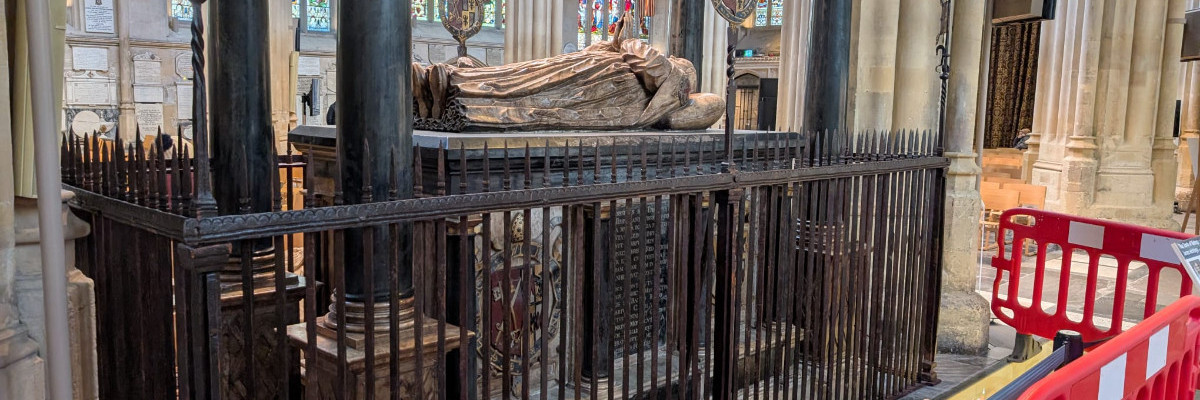
James Montague was in Northamptonshire in 1568 to Sir Edward Montagu of Boughton a landowner and politician. He studied at Christ’s College, Cambridge before becoming the first master of Sidney Sussex College, also in Cambridge in 1596. By 1603 James Montague had become the Dean of the Chapter Royal, part of the Royal Household, and was a close friend of King James I. He was a Calvinist and introduced the King to several religious radicals. In 1603 he became the Dean of Lichfield before quickly moving to be Dean of Worcester by the end of 1604. In 1608 James Montague was made the Bishop of Bath and Wells being enthroned in Wells Cathedral. It is said that whilst visiting the ruined Abbey building in Bath Bishop Montague he took shelter in the nave during a thunderstorm. This subsequently led to him personally funding much of the repair works to the Abbey building with the works being completed in 1611. Bishop Montague died in July 1618 and his body was interred in a fine alabaster tomb within the Abbey nave. Nicholas Johnson carved the effigy, and the tomb was constructed by William Cure, a local stone mason. The tomb was surrounded by a set of simple wrought iron railings.
The iron railings around the tomb consist of four, large square corner posts with tenons that pass through flat iron base rails laid onto stone. The iron base rails have round holes set at regular intervals along their length. Square palings, set on a diamond, pass through a top rail and sit down into the round holes in the base rails. Each paling has a spiked finial with a pair of forged collars at their base. The top rails are angular in shape with the outer vertical face decorated with a simple connected semi-circle pattern. At the centre of each long railing side is a further post to help support the railings. Components are held together by pins and dowels. Each corner post is topped be a decorative flag staff with lower barley twist section, forged ‘C’ sections and topped with a simple iron cross. A painted iron flag sits below each cross depicting one of two family crests. The post to the centre of each long railing side extends above the railings and is topped by a circular plaque in the form of a painted belt painted with the words from the Order of the Garter, surrounding the family crest. The railings are finish painted in a dark wine red colour.
Conservation Works
Works to the stone flooring around the Montague necessitated the dismantling and removal of the iron railings to the Montague tomb. They were transferred to a store off site whilst the stone works were undertaken. The Abbey was looking to better understand the colour history of the railings with a view to them being redecorated before they were re-instated around the Tomb. Peter Meehan ACR, was appointed by Frank Mowat, Abbey Executive Director, to take a number of paint samples and examine them to understand the colour history. Examination of 16 no. paint samples taken from various components revealed that the tomb railings had only ever had one paint system applied since fabrication and, although showing evidence for degradation, was still present on most of the ironwork components. It is very unusual for such an early paint scheme, dating from the early 17th century to survive, and is likely because of its location within the Abbey church where there is little exposure to damaging UV light, moisture and significant changes in temperature.
The paint system consisted of a layer of a carbon black paint applied by the blacksmith. This was followed by a red lead primer layer, pinky intermediate coat, two wine red topcoats topped with a resin-based varnish layer (seen to fluoresce under UV light) to give the surface a glossy appearance. It was therefore felt important that this paint finish be preserved if possible and this was the recommendation made to the Abbey. The DAC agreed the paint should be conserved rather than replaced, so a suitable specification was prepared for the appointed contractor to carry out.
Dorothea Restorations was originally appointed as the contractor to restore the railing panels and re-fit them around the tomb at the Abbey. However, with the change in approach to ensure the original paint layers were conserved, Peter Meehan ACR was retained to oversee the conservation work for the Abbey. The railing components were transferred to Dorothea’s workshop where a team lead by Ruan Bester ACR sorted the components prior to treatment. Examination of the base rails showed that the surviving paint layers were in the poorest condition with large areas badly degraded and lost, and patches of rust present in many places. As the paint layers were mostly lead-based, it was decided that the safest and best option would be to clean and repaint these rails. The paint layers to the other components were in a much better condition but with some minor losses to the red topcoats exposing the red lead primer layer beneath.
The surfaces of the components were carefully cleaned by a Dorothea team member wearing suitable PPE, to remove layers of dust, dirt and other residues using very fine 3M Scotchbrite hand pads. The paint layers were consolidated using a solution of Paraloid B67 (a methacrylate resin) dissolved in white spirit. This acted to stabilise the paint, revive the original red colour and give the surface a glossy finish. A small number of components were broken. These were repaired using small painted iron plates riveted into place to match previous repairs. The base rails were repainted using a modern alkyd paint system colour matched to the original finish. Dorothea Restorations’ team installed the conserved railings back around Bishop Montague’s tomb over several days, having to drill some fixing holes for the posts into the new stonework. After laying the base rail and fitting the posts, the railings were carefully re-assembled. They were then finished with an application of a microcrystalline-based wax coating applied using soft clothes. Peter Meehan ACR was asked by the Abbey to inspect the re-instated railings to confirm they were conserved as specified. The team at Dorothea Restorations had done an excellent job conserving the surviving original paint finish to these important early wrought iron railings with their work ensuring they will last for many years to come.
- June 2026 (1)
- February 2026 (1)
- November 2025 (1)
- August 2025 (1)
- March 2025 (1)
- January 2025 (1)
- September 2024 (1)
- July 2023 (2)
- December 2022 (1)
- November 2022 (1)
- April 2022 (3)
- April 2021 (1)
- January 2021 (1)
- December 2019 (2)
- May 2018 (1)
- December 2017 (2)
- April 2017 (1)
- March 2017 (1)
- January 2017 (1)
- August 2016 (2)
- April 2016 (3)
- March 2016 (1)
- August 2015 (1)
- July 2015 (1)
- May 2015 (1)
- January 2015 (1)
- October 2014 (3)
- September 2014 (1)