Restoration of the historic wrought iron canopy at the Palace Theatre in London
10th June 2026
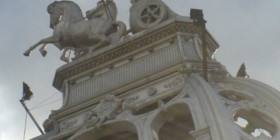
Dorothea Restorations were appointed to carry out specialist repair works to the historic canopy at the Palace Theatre—an architecturally sensitive element requiring both technical expertise and a conservation-led approach.
At the heart of the project was the careful balance between preserving original fabric and introducing durable repair solutions that respect the structure’s historic integrity. As is often the case with heritage structures, site conditions required ongoing review and coordination. Any deviations from the original scope required careful assessment and agreement to ensure the integrity of both the design and the conservation approach was maintained. Close collaboration between workshop, site teams, and project management proved essential to maintaining quality and programme.
Working on historically significant structures demands more than standard repair techniques. Each intervention must:
- Respect the original detailing and fabrication methods
- Avoid introducing unnecessary stress into existing materials
- Ensure long-term durability without compromising authenticity
At the Palace Theatre, this meant adopting a measured approach—carefully reviewing each element before intervention and adjusting methods where required.
The repair works to the canopy began with a fundamental conservation principle: understand the material before intervening.
The existing paint system was removed by abrasive cleaning to expose the underlying fabric and allow full identification of defects such as cracking, distortion, and historic repairs.
This process also revealed original wrought iron stamps including:
- “BEST” – indicating the high grade, refined wrought iron
- “Crown” – associated with British-regulated iron production
- “Thistle” – typically denoting Scottish manufacture or import via Scotland
These markings confirmed that the canopy is fabricated from high-quality historic wrought iron, reinforcing the need for a careful and sympathetic conservation approach.
Following cleaning, each spandrel bracket was individually photographed and inspected to determine the scope of works.
The key issues identified included:
- Distortion and impact damage affecting anchor points
- Damaged or redundant "T-brackets" used to secure the modern gutter
- Modern steel additions welded to support obsolete services
- The need to assess existing rivets and fixings prior to recoatin
This systematic inspection ensured that intervention was targeted, minimal, and evidence-based.
Where original material had been bent or twisted, it was first inspected to ensure no cracking or structural failure had occurred.
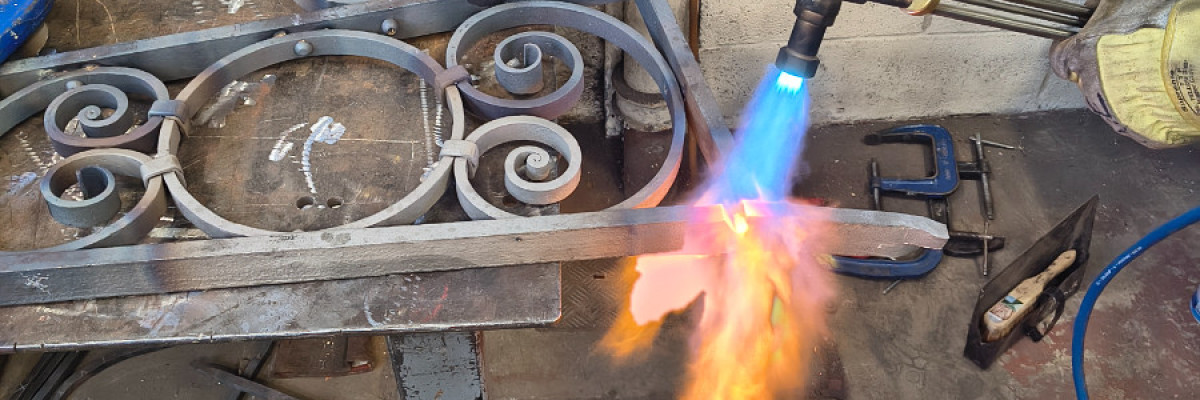
Where suitable, distortion was corrected using:
- Localised heating with oxy-propane torching
- Manual adjustment using bespoke tools, presses, or clamps
- Controlled, natural cooling to stabilise the material
This method allows deformation to be relieved without compromising the integrity of the historic iron.
Where material failure was identified:
- Defective sections were dressed back to sound metal
- Remaining material was realigned
- Full-depth welds were introduced to reinstate structural integrity
Mechanical fixings were reinstated using rivets or drilled-and-tapped fixings on a like-for-like basis, preserving the original construction methodology.
The canopy included traditional Whitworth bolts securing critical connections between components.
Many of these had:
- Corroded
- Seized
- Been distorted through impact
Where performance was compromised, fixings were replaced strictly like-for-like, matching original form and function.
Modern steel additions, previously welded to the wrought iron to support redundant lighting conduits, were carefully removed.
- Welds were cut away
- Surfaces were dressed by hand
- Original material was preserved with minimal loss
This ensured the structure was returned as closely as possible to its original configuration, removing non-historic interventions.
A Conservation-Led Outcome
The Palace Theatre canopy project demonstrates the core principles of Dorothea Restorations’ approach:
- Minimum intervention, maximum retention of original fabric
- Use of traditional techniques alongside modern understanding
- Like-for-like repairs to preserve authenticity
- Careful removal of inappropriate later alterations
By working with the material—rather than replacing it—the project ensures the continued structural performance and historic integrity of this important architectural feature.
- June 2026 (1)
- February 2026 (1)
- November 2025 (1)
- August 2025 (1)
- March 2025 (1)
- January 2025 (1)
- September 2024 (1)
- July 2023 (2)
- December 2022 (1)
- November 2022 (1)
- April 2022 (3)
- April 2021 (1)
- January 2021 (1)
- December 2019 (2)
- May 2018 (1)
- December 2017 (2)
- April 2017 (1)
- March 2017 (1)
- January 2017 (1)
- August 2016 (2)
- April 2016 (3)
- March 2016 (1)
- August 2015 (1)
- July 2015 (1)
- May 2015 (1)
- January 2015 (1)
- October 2014 (3)
- September 2014 (1)