The jewel of Scotland is Preston Mill
16th February 2026
Preston Mill, a Category A listed building, is a historic watermill located on the River Tyne at the eastern edge of East Linton in East Lothian. Although milling has taken place on this site since at least the 16th century, the present structure dates from the 18th century.
The mill remained in commercial use until 1959, primarily producing oatmeal, and was the last working watermill in the Lothians. It was also the first industrial building to be taken into the care of the National Trust for Scotland.
The complex comprises the mill building, kiln, and granary, with the existing waterwheel last replaced in 1909. Today, the site is particularly noted for the kiln’s distinctive conical red pantile roof, which continues to attract visitors, artists, and filmmakers alike.
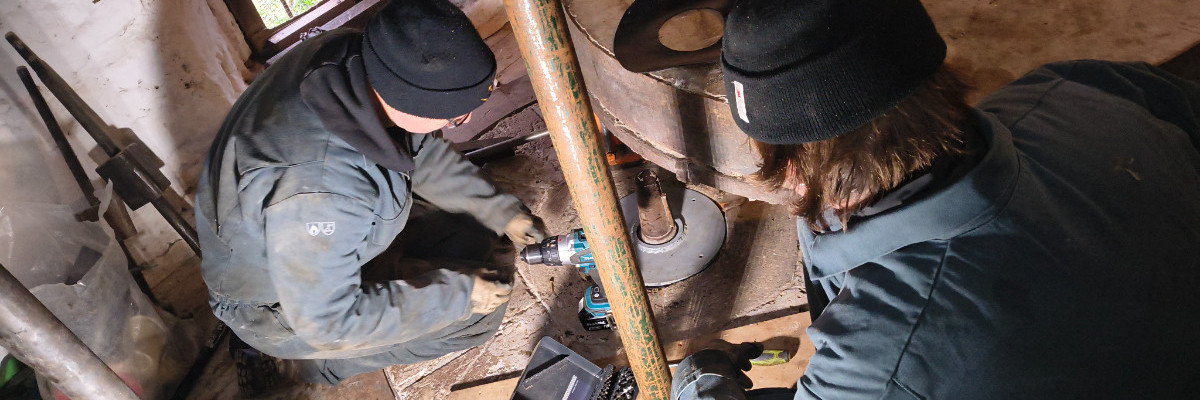
During 2025 and 2026, our team undertook a programme of repair and restoration works both on site in Scotland and within the workshop, focusing on returning the mill machinery to a functional condition suitable for demonstration.
Previous flooding events had caused significant mechanical degradation, with debris ingress leading to excessive wear across bearings and draive shafts. Much of the intervention therefore centred on stabilising and reinstating these working elements while retaining as much historic fabric as possible.
The works included:
- Minor repairs to the waterwheel sluice mechanism
- Replacement of missing wedges to the pit wheel and subsequent realignment
- Casting and installation of a new upright shaft foot bearing
- Replacement of foot bearings to the mill stones
- Full dressing of one set of mill stones
- Alignment and fitting of the neck box
- Balancing of the runner stone (as far as practicable within existing tolerances)
- Testing and commissioning of the machinery
Particular emphasis was placed on the dressing and alignment of the millstones, ensuring both mechanical performance and authenticity in operation. All works were undertaken with careful consideration of the mill’s historic significance and the need to preserve operational integrity for public demonstration.
The completed works have enabled the mill machinery to operate once again, providing a clear demonstration of traditional milling processes. Beyond the technical achievement, the project ensures that Preston Mill continues to function not just as a static historic structure, but as a working example of Scotland’s rural industrial heritage.
- June 2026 (1)
- February 2026 (1)
- November 2025 (1)
- August 2025 (1)
- March 2025 (1)
- January 2025 (1)
- September 2024 (1)
- July 2023 (2)
- December 2022 (1)
- November 2022 (1)
- April 2022 (3)
- April 2021 (1)
- January 2021 (1)
- December 2019 (2)
- May 2018 (1)
- December 2017 (2)
- April 2017 (1)
- March 2017 (1)
- January 2017 (1)
- August 2016 (2)
- April 2016 (3)
- March 2016 (1)
- August 2015 (1)
- July 2015 (1)
- May 2015 (1)
- January 2015 (1)
- October 2014 (3)
- September 2014 (1)